X is the number of arrivals in a poisson process within a fixed period of time. The inter-arrival times follow an exponential distribution. The following small benchmark makes an attempt to compare the time necessary to compute samples using three different algorithms:
- Algorithm exp, do it yourself
- Algorithm uni by D. Knuth
- Algorithm rou, from Numerical Recipes
(Let’s peek at the results up-front: rou seems to win this challenge!)
exp - counting inter-arrival times
We want a random sample of the number of arrivals within a fixed period of time. We know the distribution of the inter-arrival times. By summing up inter-arrival times until the sum exceeds the fixed period of time (use the unit interval for convenience) we generate a sample number of arrivals. Formalizing this idea, we have a sequence of exponentially distributed random values:
$$T_1, T_2, T_3 \dots \qquad \sim \qquad Exp(\lambda)$$The i-th interval represents the time until the i-th arrival. We then find a number k such that
$$\sum_{i=1}^k T_i \le 1 \le \sum_{i=1}^{k+1} T_i $$This number k is the sought-after random sample.
double exponential(Ran *ran, double lambda) {
    double p;
    do {
        p = ran->doub();
    } while (p == 0.);
    return -log(p) / lambda;
}

int poisson_exp(Ran *ran, double lambda) {
    double t = 0;
    int k = 0;
    while (1) {
        t += exponential(ran, lambda);
        if (t > 1) {
            return k;
        } else {
            k++;
        }
    }
}
uni - counting inter-arrival times, improved
Usually, the inversion method is used for sampling from an exponential distribution.
$$U_1, U_2, U_3 \dots \qquad \sim \qquad Uniform(0, 1)$$then
$$T_i = - \frac{1}{\lambda} \ln U_i \qquad \sim \qquad Exp(\lambda) $$Note the logarithm. It is the computationally most expensive operation when generating a sample inter-arrival time. Knuth’s variant gets rid of this nuisance. Here’s how it works
$$ \begin{aligned} \sum_{i=1}^k T_i &\le 1 \le \sum_{i=1}^{k+1} T_i \\ \sum_{i=1}^k \left( - \frac{1}{\lambda} \right) \ln U_i &\le 1 \le \sum_{i=1}^{k+1} \left( - \frac{1}{\lambda} \right) \ln U_i \\ \sum_{i=1}^{k+1} \ln U_i &\le - \lambda \le \sum_{i=1}^{k} \ln U_i \\ \ln \prod_{i=1}^{k+1} U_i &\le - \lambda \le \ln \prod_{i=1}^{k} U_i \\ \prod_{i=1}^{k+1} U_i &\le \exp(-\lambda) \le \prod_{i=1}^{k} U_i \end{aligned} $$Finding a k that satisfies the last inequation only requires λ+1 uniform samples on average, reflecting in shortened computation times.
int poisson_uni(Ran *ran, double lambda) {
    int k = -1;
    double p = 1.;
    double lambda_exp = exp(-lambda);
    do {
        k++;
        p *= ran->doub();
    } while (p > lambda_exp);
    return k;
}
rou - using Ratio-of-Uniforms method
No explanation here (unfortunately…). Just take the algorithm from Numerical Recipes and see what it’s worth. Actually, I modified it to use Ratio-of-Uniforms for all values of λ for the sake of comparison. Sources are licensed and therefore cannot be listed here.
Benchmark
Taking different values for λ (1, 2, 4, 16, 32, 64) and generating a million random samples using each of the three algorithms on a notebook from 2008, here’s the results (interpolated).
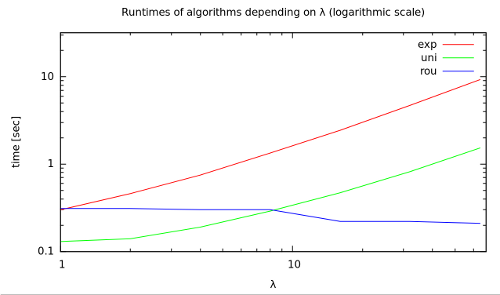
 g++ -O2 benchmark.cpp -I . -o benchmark
./benchmark
 Numbers generated per algorithm: 1000000
Expected value: 1
    method       mean   time [s]
       uni      1.000      0.130
       exp      0.998      0.300
       rou      1.036      0.310
 Numbers generated per algorithm: 1000000
Expected value: 2
    method       mean   time [s]
       uni      2.001      0.140
       exp      2.000      0.460
       rou      2.008      0.310
 Numbers generated per algorithm: 1000000
Expected value: 4
    method       mean   time [s]
       uni      3.999      0.190
       exp      3.999      0.750
       rou      4.000      0.300
 Numbers generated per algorithm: 1000000
Expected value: 8
    method       mean   time [s]
       uni      8.000      0.290
       exp      8.000      1.340
       rou      8.001      0.300
 Numbers generated per algorithm: 1000000
Expected value: 16
    method       mean   time [s]
       uni     16.002      0.470
       exp     15.996      2.440
       rou     16.000      0.220
 Numbers generated per algorithm: 1000000
Expected value: 32
    method       mean   time [s]
       uni     32.007      0.820
       exp     32.001      4.710
       rou     31.996      0.220
 Numbers generated per algorithm: 1000000
Expected value: 64
    method       mean   time [s]
       uni     63.982      1.530
       exp     64.009      9.270
       rou     63.995      0.210
Sources
benchmark.zip : In order to compile, you need to obtain files nr3.h, ran.h, deviates.h, gamma.h from Numerical Recipes and put them into the folder with the other source files.