11. Februar 2012
Template Tracking using Hyperplane Approximation
 Tracking an object over a sequence of 2D images is a challenging task. One approach uses a linear mapping between observed intensity differences and target motion; this is presented in the paper Hyperplane Approximation for Template Matching by F, Jurie and M. Dhome. Here are some results from an implementation in Matlab by a fellow student and me.
12. Januar 2012
Fix for Wireless Presenters and Flash-based Full-screen Prezi
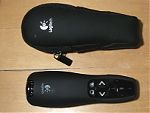 Your wireless presenter is not working for prezi.com in full-screen mode? Here is how you might be able to fix the issue on X-based Linux desktops by temporarily remapping the “Page Up” and “Page Down” buttons of your keyboard.
6. Dezember 2011
Reinventing the Wheel: Panorama Stitching with Matlab
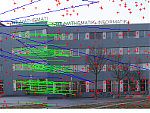 A set of images that have some common overlapping regions can be stichted together to form a panorama picture. Some recent camera models can even compute the panorama picture internally and do not require post-processing on the computer. While this is a problem that has already been solved (for example, there is AutoStitch, here are some hints on classic DIY-panorama-stitching using Matlab, SIFT, DLT and RANSAC.
9. November 2011
Saving the Parrots with Homogeneous Coordinates
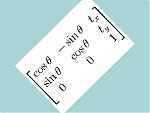 A well-known result from linear algebra is that one can use a matrix to represent any linear mapping between two vector spaces. While rotation is a linear mapping, translation unfortunately is not. But, wait… by adding another dimension to the vector space, and by interpreting the vector coordinates correctly, we are able to perform rotation and translation with a single matrix multiplication! This article describes how to restore a fragmented image with the help of homogeneous coordinates.
22. Oktober 2011
A Connection between Motion Blur and the Fourier Transform
Motion blur usually occurs in an image, when the camera was moved with respect to the subject. Motion blur has an interesting effect on the Fourier-transformed image, as pointed out by D. Burschka at University of Technology, Munich. Here is an example how the Fourier-transformed images of toy images look like that have been subject to motion blur.
— More ...21. Oktober 2011
Disabling hot-corner effect in Gnome 3
When using Gnome 3, one can access the dashboard by moving the cursor to the top-left corner of the screen. As it turns out, I always kept accidentally moving the cursor to this “hot corner”, thereby opening the dashboard involuntarily. Here is a small hack that disables this hot-corner effect. You are still able to show the dashboard by activating the “super” key.
— More ...8. Oktober 2011
Dual-booting Arch and Ubuntu with LVM on top of LUKS
Encrypting your hard drive is generally a good idea. Yet, the encryption renders dual-booting a little more difficult. Here I briefly sketch how I installed Ubuntu in parallel to an existing Arch installation on a LUKS-encrypted drive.
— More ...27. Mai 2011
Team Black Sheep presents amazing stunts with first-person-view RC plane
Being suprised by a low-flying unidentified objects? Maybe it was just a remote-controlled airplane by Team Black Sheep, who were giving a talk at TNG Big Techday in Munich on 2011-05-27.
— More ...13. Mai 2011
Sampling from a Poisson distribution - a benchmark
Having a poisson-distributed random variable X, how can we efficiently generate samples (or say realizations) of that random variable? This article shows how Knuth’s technique can be derived and it also indicates that the Ratio-of-Uniforms method is quite efficient.
— More ...14. Oktober 2010
Nearest-Neighbor-Resampling in Matlab
This article shows the derivation of an algorithm for resizing images in Matlab, using nearest-neighbor interpolation. Scaling an image is mathematically just multiplying image coordinates by a scaling factor. Surprisingly, when dealing with digital images, the scaling process becomes a little bit more complex.
— More ...16. Juni 2010
Hosting bei Dreamhost, Domain woanders
Über wenige Webhosts lassen sich beliebige Top-Level-Domains registrieren. Beispielsweise ist es derzeit (Juni 2010) bei Dreamhost nicht möglich, de-Domains zu bestellen. Bei deutschen Anbietern wiederum ist dies möglich, im Niedrigpreissektor z.B. bei Evanzo. Bei Evanzo hat man Zugriff auf die DNS-Einträge der Domäne.
— More ...20. Mai 2010
Eine weitere Identität für Binomialkoeffizienten
Keine besonders umwerfende Erkenntnis, aber diese Identität hat mir letztens weitergeholfen:
— More ...27. April 2010
Remote Procedure Calls über den DBus
Wozu dient der DBus? Und wie spricht man ihn an? Ein einfaches Beispiel in fünf verschiedenen Sprachen —- mit Java, OCaml, Python, C und der Shell!
— More ...11. April 2010
2D-Grafik-Ausgabe mit Cairo und OCaml
2. Oktober 2009
Programmierkonzepte für Multi-Core-Prozessoren
This article briefly introduces some existing programming concepts. It is a summary of a couple of interesting approaches that were presented at Ferienakademie 2009.
— More ...16. September 2009
Funktionsgraphen zeichnen mit PostScript
PostScript ist eine Programmiersprache, die zur Beschreibung von Seiten dient. Mit ihr programmiert man direkt auf dem Stack und nutzt dabei die umgekehrte polnische Notation, was einigen Spaß bereitet, sobald man mal den Dreh herausgefunden hat. Mit PostScript kann man programmatisch skalierbare Grafiken zeichnen.
— More ...